

The cosmetics industry is changing faster than ever.
Today’s customers are no longer buying beauty products blindly. They carefully check ingredients, compare labels, search for clean beauty claims, and choose brands that match their personal values.
And this is where the debate between natural vs synthetic cosmetics becomes extremely important for every private label cosmetics business.
Let’s be practical.
Some consumers prefer natural skincare products because they believe plant-based ingredients feel safer, cleaner, and more eco-friendly. On the other hand, many buyers still trust synthetic cosmetics for better stability, advanced formulations, affordability, and long-lasting performance.
Now the real challenge for private label brands is this:
Which option actually works better for business growth?
Because choosing the right cosmetic formulation is not only about ingredients anymore. It directly affects your product pricing, target audience, shelf life, branding strategy, manufacturing cost, and overall market positioning.
In today’s highly competitive beauty market, brands that understand customer psychology and ingredient trends are growing much faster than others. Some businesses focus completely on natural beauty products, while many successful cosmetic manufacturers now combine natural and synthetic ingredients to create high-performance formulations.
This guide will help you understand the real difference between natural and synthetic cosmetics, their business advantages, consumer demand, and which option can help your private label skincare brand grow faster in today’s market.
What Are Natural Cosmetics?
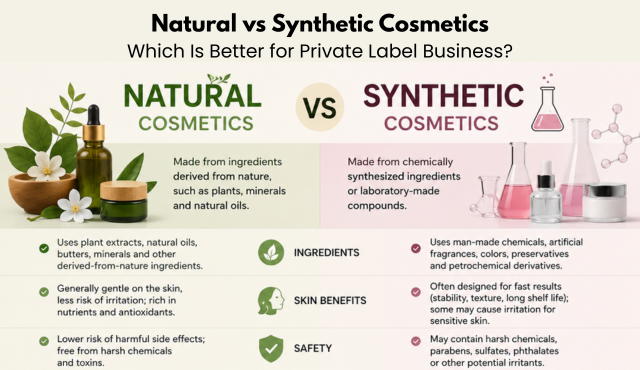
Natural cosmetics are beauty and personal care products made mainly from ingredients found in nature, such as plant extracts, essential oils, herbs, minerals, and natural butters. These products are usually created with minimal chemical processing and are popular among consumers looking for clean beauty and eco-friendly skincare.
Natural cosmetics often avoid harsh chemicals, artificial fragrances, and parabens. They are commonly used in skincare, haircare, and organic beauty brands that focus on sustainability, gentle formulations, and naturally derived ingredients for healthier skin and beauty routines.
What Are Synthetic Cosmetics?
Synthetic cosmetics are beauty products made using scientifically created ingredients developed in laboratories. These ingredients are designed to improve product stability, texture, shelf life, fragrance, colour, and performance. Synthetic formulations are widely used in skincare, makeup, haircare, and personal care products because they are cost-effective and provide consistent results.
Many advanced cosmetic products use synthetic ingredients to target specific skin concerns like ageing, acne, pigmentation, and dryness. They also help manufacturers produce large quantities of products while maintaining quality, safety, and long-lasting effectiveness.
Natural vs Synthetic: Key Differences That You Should Consider
Choosing between natural and synthetic cosmetics is no longer only about ingredients. It also affects business goals, customer expectations, product performance, and long-term brand positioning in the beauty industry. Every Cosmetics Manufacturer must carefully evaluate formulation quality, market demand, pricing strategy, and consumer preferences before selecting the right cosmetic approach for private label products.
a) Ingredient Sourcing
Natural cosmetics use plant-based extracts, herbs, oils, and minerals sourced from nature. Synthetic cosmetics use lab-created ingredients designed for consistency and large-scale manufacturing.
b) Cost Comparison
Natural ingredients are often expensive because of farming, extraction, and limited availability. Synthetic ingredients are usually more affordable, making them suitable for mass-market cosmetic brands.
c) Shelf Life & Preservation
Natural beauty products may have a shorter shelf life due to fewer preservatives. Synthetic cosmetics generally last longer and remain stable under different storage conditions.
d) Performance & Effectiveness
Synthetic formulations are often designed for targeted skincare concerns like acne, pigmentation, or anti-ageing. Natural cosmetics are preferred for gentle skincare and clean beauty preferences.
e) Consumer Perception & Branding
Natural skincare products attract eco-conscious consumers who prefer organic and sustainable beauty. Synthetic cosmetics appeal to buyers looking for affordability, innovation, and fast results.
Both natural and synthetic cosmetics have strong market demand today. The right choice depends on your private label business goals, target audience, pricing strategy, and overall cosmetic brand positioning.
Which Is Better for Your Private Label Business?
Success in the private label cosmetics industry is no longer based only on attractive packaging or trendy ingredients. The real growth comes from understanding what your buyers actually expect from your beauty brand.
i) Define Your Target Audience
Every cosmetic buyer has different preferences. Some customers actively search for natural skincare products made with herbal or organic ingredients. Others care more about fast results, advanced formulations, and affordable pricing offered by synthetic cosmetics.
ii) Brand Positioning Strategy
Your product formulation strongly shapes your brand image in the market. Natural cosmetics help brands build a clean beauty, eco-friendly, and premium identity. Synthetic formulations are often linked with innovation, scientific skincare, and performance-driven beauty solutions.
iii) Pricing & Profit Margins
Budget planning becomes extremely important while launching a private label beauty brand. Natural ingredients can raise manufacturing costs because sourcing and preservation are expensive. Synthetic ingredients usually allow brands to maintain stable pricing and stronger profit margins.
iv) Compliance & Certifications
Beauty products must follow cosmetic regulations before entering the market. Natural cosmetic brands often need organic, cruelty-free, or vegan certifications to gain customer trust. Synthetic cosmetics also require proper testing, ingredient transparency, and safety approvals.
Modern beauty brands are no longer choosing only one side. Many successful private label businesses now blend natural and synthetic ingredients to create balanced, high-performing, and market-friendly cosmetic products.
Conclusion:
The debate between natural and synthetic cosmetics does not have a one-size-fits-all answer. Both categories offer unique advantages depending on your private label business goals, customer preferences, pricing strategy, and brand identity. While natural cosmetics help attract clean beauty and eco-conscious consumers, synthetic formulations provide stability, affordability, and advanced skincare performance.
The smartest beauty brands today focus on balance instead of extremes. Many successful cosmetic companies now combine natural and synthetic ingredients to create products that deliver both safety and effectiveness.
If you are planning to launch a skincare, haircare, or personal care brand, partnering with the right cosmetic manufacturer becomes extremely important. RevieraOverseas offers private label cosmetic manufacturing solutions tailored to modern market trends, helping brands create high-quality products with customised formulations and packaging support.
The future of the beauty industry belongs to brands that understand consumer expectations, ingredient transparency, and product innovation together.