

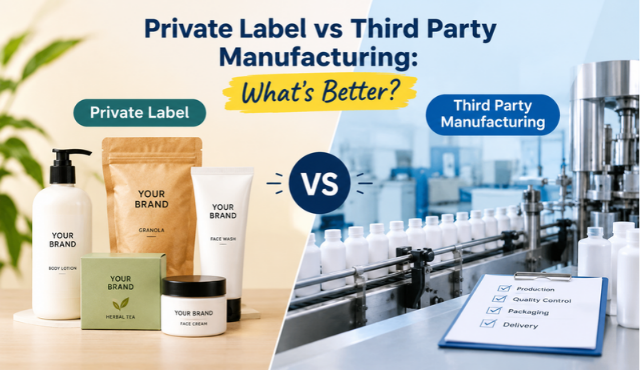
Launching a new product does not always mean setting up your own manufacturing facility. Brands can work with specialized manufacturers through models such as private label and third party manufacturing.
Both options allow businesses to bring products to market without managing the complete production infrastructure, but they differ in formulation, customization, development requirements, costs, and product ownership.
The right choice depends on your brand strategy, target customers, budget, desired level of customization, and long-term growth plans. A startup testing a new category may prioritize speed and lower development costs, while an established brand may want a more differentiated product with greater control over formulation.
So, private label vs third party manufacturing, which option is better for your cosmetics business? Let’s compare both models, their benefits and limitations, and the factors that can help you make a more informed decision.
What Is Private Label Manufacturing?
Private label manufacturing is a model where a cosmetics manufacturer produces products that are sold under another company’s brand name. The manufacturer generally has existing formulations or ready-to-produce products that can be selected by the brand.
The brand owner typically focuses on product selection, branding, packaging, marketing, distribution, and sales, while the manufacturer manages production. Depending on the agreement, the brand may be able to make certain changes to fragrance, packaging, colour, size, or other product attributes.
This model is particularly useful for startups, retailers, e-commerce businesses, and companies that want to enter a product category without investing heavily in research and development.
For example, a cosmetics brand may select an existing skincare formulation from a manufacturer, sell it under its own brand name, and customize the packaging and presentation according to its market positioning.
What Is Third Party Manufacturing?
Third party manufacturing involves hiring an external manufacturer to produce products on behalf of a brand. Unlike a simple ready-formula private label arrangement, third party manufacturing can offer greater flexibility in product development and customization.
A brand may use an existing formulation or work with the manufacturer to develop a product according to specific requirements.
Depending on the manufacturer and agreement, the process can involve formulation development, testing, packaging, production, quality control, and other manufacturing activities.
This approach can be suitable for brands looking to develop products with specific performance characteristics, ingredients, textures, fragrances, formats, or other requirements.
Third party manufacturing can therefore provide a wider scope for product differentiation, although custom development may require more time, technical involvement, and initial investment.
Private Label vs Third Party Manufacturing: Key Differences
While both models involve outsourcing production, the level of customization and product development can differ significantly.
The biggest distinction is the degree of product development and customization. Private label is often more straightforward when a brand wants to select an existing product and bring it to market quickly. Third party manufacturing can be more appropriate when the brand wants greater involvement in how the final product is developed.
However, these terms can overlap in the industry, and manufacturers may define their services differently. Businesses should therefore clarify formulation ownership, customization rights, MOQ, testing, documentation, packaging responsibilities, and other commercial terms before entering an agreement.
Private Label vs Third Party Manufacturing: Advantages and Disadvantages
a) Advantages of Private Label
Faster market entry: Since manufacturers generally offer existing formulations, brands can reduce the time required for product development.
Lower development requirements: Businesses do not necessarily need extensive R&D resources when selecting from an established product range.
Lower initial investment: Private label can reduce some of the costs associated with developing a completely new formulation.
Simpler operations: The manufacturer handles production, allowing the brand to concentrate on branding, packaging, marketing, sales, and distribution.
Useful for market testing: Startups can use private label products to test customer demand before investing in extensive product development.
b) Disadvantages of Private Label
Limited differentiation: When multiple brands use similar or identical base formulations, creating a highly distinctive product can be challenging.
Less formulation control: Brands may have limited influence over the composition or technical characteristics of an existing product.
Potential competition: Similar products may be available to other businesses working with the same manufacturer.
Formula ownership concerns: The brand should carefully review the agreement to understand whether it owns the formulation, has exclusive rights, or is simply licensing or purchasing an existing product.
Customization limitations: Extensive modifications may not always be possible without additional development work.
c) Advantages of Third Party Manufacturing
Greater customization: Brands can potentially develop products according to specific market requirements, positioning, or customer preferences.
Higher differentiation: Custom formulations can help a brand create a more distinctive product proposition.
Access to manufacturing expertise: Businesses can work with manufacturers that already have the equipment, technical knowledge, production capabilities, and quality systems required for manufacturing.
Scalable production: Once the product is successfully developed and validated, production can often be scaled according to business growth.
Greater product control: Depending on the agreement, brands may have more involvement in formulation, specifications, packaging formats, and production requirements.
d) Disadvantages of Third Party Manufacturing
Longer development timelines: Custom formulation, testing, approvals, sampling, and production planning can increase the time required to launch.
Higher development costs: A customized product may require additional R&D, testing, samples, ingredients, packaging development, or technical work.
More decision-making: The brand may need to participate more actively in product development and approval stages.
Higher complexity: Custom products can involve additional documentation, quality checks, regulatory considerations, and production coordination.
Minimum order requirements: Customized manufacturing may involve higher MOQs depending on ingredients, packaging materials, production processes, and economies of scale.
Which Is Better: Private Label or Third Party Manufacturing?
There is no universal winner in the private label vs third party manufacturing comparison. The better option depends on what your brand needs at its current stage.
Private label can make sense when your priority is speed, simplicity, lower development requirements, and market testing. It can be a practical route for startups and businesses entering a new product category.
Third party manufacturing may be more suitable when your priority is customization, product differentiation, formulation control, and long-term brand development. It can offer greater flexibility when an existing formulation does not fully meet your product vision.
Before choosing a manufacturer, compare more than just the quoted production price. Review MOQ, formulation ownership, customization options, testing facilities, quality standards, certifications, packaging support, lead times, scalability, and contractual terms.
Conclusion:
Private label and third party manufacturing both provide practical ways for brands to outsource production without establishing their own manufacturing infrastructure. The right choice comes down to your product strategy, budget, timeline, desired customization, and growth objectives.
If you want to launch quickly with an existing formulation, private label manufacturing may be the more efficient route. If creating a differentiated product is central to your brand strategy, third party manufacturing can provide greater scope for customization and development.
For businesses looking for reliable third party manufacturing, private label manufacturing, and customized product development, working with an experienced manufacturing partner can simplify the journey from concept to finished product. Evaluate your requirements carefully, discuss your expectations with potential manufacturers, and choose a partner that can support both your immediate launch and long-term scalability.