

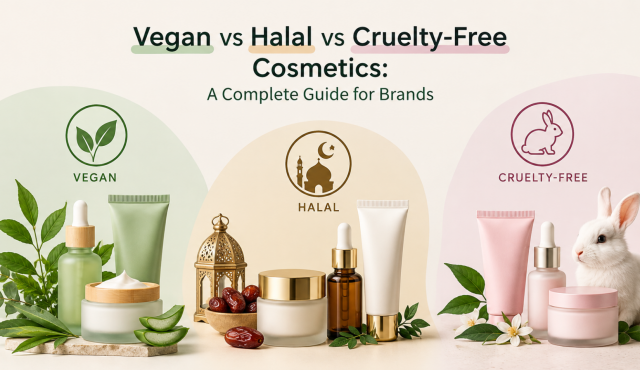
The beauty industry is moving beyond traditional product claims, with vegan, halal, and cruelty-free cosmetics becoming important considerations for brands, manufacturers, and consumers. While these terms are often used together, they represent different standards related to ingredients, sourcing, religious compliance, and animal testing. For brands entering ethical beauty markets, understanding these differences is essential for accurate product positioning and credible claims.
The market opportunity is significant. The global vegan cosmetics market was valued at USD 15.17 billion in 2021 and is projected to reach USD 26.16 billion by 2030, while India’s vegan cosmetics market is expected to grow at a 9.4% CAGR through 2030. Meanwhile, the global cruelty-free cosmetics market is projected to reach USD 23.54 billion by 2030.
This guide explains vegan vs halal vs cruelty-free cosmetics, their key differences, certification considerations, formulation requirements, and how brands can choose the right positioning for their target markets.
What Are Vegan Cosmetics?
Vegan cosmetics are beauty and personal-care products formulated without ingredients derived from animals or animal by-products. Common excluded ingredients include beeswax, honey, lanolin, collagen, keratin, and carmine. Vegan formulations typically use plant-based, mineral, or synthetic alternatives. Brands should distinguish a vegan claim from cruelty-free status because vegan products are not automatically free from animal testing.
What Are Halal Cosmetics?
Halal cosmetics are products formulated, manufactured, and handled according to Islamic principles. They generally avoid prohibited ingredients such as pork-derived substances, certain animal-derived materials, and alcohol sources that do not meet applicable halal requirements. Halal certification can also consider manufacturing processes, contamination controls, storage, and supply chains, making compliance broader than simply checking individual ingredients.
What Are Cruelty-Free Cosmetics?
Cruelty-free cosmetics are products developed without animal testing at relevant stages of product development, depending on the standard or certification used. A cruelty-free claim primarily concerns testing practices, not whether ingredients are animal-derived. Therefore, a product can be cruelty-free while containing ingredients such as beeswax or honey. Certification standards and definitions can vary by market and organization.
Can Cosmetics Be Vegan, Halal, and Cruelty-Free?
Yes, cosmetics can be vegan, halal, and cruelty-free at the same time, provided the formulation, sourcing, manufacturing, and testing practices meet the requirements of all three claims.
A product must avoid animal-derived ingredients to qualify as vegan, comply with applicable halal standards, and meet the relevant cruelty-free requirements regarding animal testing. For cosmetic brands, combining these claims can broaden market appeal, particularly among consumers seeking ethical, faith-compliant, and animal-conscious beauty products. Clear certification and transparent documentation can strengthen credibility.
Vegan vs Halal vs Cruelty-Free Cosmetics Comparison
Vegan, halal, and cruelty-free cosmetics address different aspects of product development, so brands should not treat these terms as interchangeable. Vegan focuses primarily on ingredients and excludes animal-derived substances. Halal covers ingredients as well as relevant manufacturing, handling, and contamination requirements under Islamic principles. Cruelty-free primarily concerns animal testing. A cosmetic product can meet all three standards when its formulation, sourcing, production, and testing practices satisfy the applicable requirements.
| Criteria | Vegan Cosmetics | Halal Cosmetics | Cruelty-Free Cosmetics |
|---|---|---|---|
| Main focus | Ingredients | Ingredients + processes | Animal testing |
| Animal-derived ingredients | Not permitted | Restricted depending on source | May be permitted |
| Animal testing | Not automatically excluded | Not the primary criterion | Excluded under applicable standard |
| Religious compliance | No | Yes, Islamic requirements | No |
| Certification | Depends on certifier | Often important | Depends on certifier |
| Can overlap? | Yes | Yes | Yes |
For brands, understanding these distinctions helps prevent misleading claims, supports accurate cosmetic labeling, and makes product positioning clearer across different consumer markets.
Why Do These Claims Matter for Cosmetic Brands?
Consumers today increasingly want to know not only what a cosmetic product does, but also how it is formulated, sourced, and tested. For brands, vegan, halal, and cruelty-free claims can therefore support trust, differentiation, market reach, and premium positioning when these claims are accurate and properly substantiated.
a) Consumer Trust
Clear vegan, halal, and cruelty-free claims help consumers understand a product’s ingredients, ethical considerations, and production standards. Transparent documentation and credible certification can make these claims more trustworthy.
b) Product Differentiation
In a competitive beauty market, verified claims can give products a distinct identity. Brands can use ethical and ingredient-focused positioning to differentiate their cosmetics beyond performance, fragrance, packaging, or price.
c) International Market Expansion
These claims can help brands address specific consumer requirements across international markets. Halal compliance can be particularly relevant in Muslim-majority markets, while vegan and cruelty-free positioning can appeal to consumers seeking plant-based and animal-conscious products.
d) Premium Brand Positioning
For premium and clean-beauty brands, well-supported ethical claims can reinforce perceptions of transparency, responsible sourcing, and thoughtful formulation. They can become part of a broader brand strategy rather than simply a label claim.
Ultimately, these claims are most valuable when they reflect genuine formulation and manufacturing practices and are communicated accurately across packaging, websites, and marketing channels.
How to Develop a Vegan, Halal, or Cruelty-Free Cosmetic Product?
Developing a vegan, halal, or cruelty-free cosmetic product requires more than changing a few ingredients. Brands need to align formulation, sourcing, manufacturing, certification, and packaging claims from the beginning. A structured approach helps reduce compliance risks and creates a product that can be marketed confidently.
Step 1: Define Your Target Consumer
Identify whether you are targeting vegan consumers, halal markets, cruelty-free buyers, or a combination of these segments. This determines formulation and certification priorities.
Step 2: Establish the Claim Strategy
Decide which claims the product will carry and understand the requirements behind each claim before development begins.
Step 3: Review the Formula
Screen every ingredient for animal-derived materials, restricted substances, and other formulation requirements relevant to your chosen positioning.
Step 4: Verify Ingredient Sources
Obtain supplier documentation confirming ingredient origin, processing, and relevant compliance information.
Step 5: Review the Manufacturing Process
Check production, cleaning, storage, and handling procedures to prevent prohibited cross-contamination.
Step 6: Select Appropriate Certification
Choose credible certification according to your target market and product claims.
Step 7: Build Packaging Claims Carefully
Use accurate, substantiated claims and avoid wording that could mislead consumers.
A well-planned development process helps brands create credible, market-ready cosmetics while building stronger consumer confidence.
Should a Cosmetic Brand Get All Three Certifications?
Getting vegan, halal, and cruelty-free certifications can strengthen a cosmetic brand’s market positioning, but obtaining all three is not necessary for every product or cosmetics business. The right combination depends on the target audience, export markets, formulation, and brand strategy.
- Target audience: Choose certifications that match the values and purchasing priorities of your intended consumers.
- Product formulation: If your formula already meets multiple standards, pursuing additional certifications may require fewer changes.
- Export markets: Certification can support market entry where retailers, distributors, or consumers expect specific ethical or religious standards.
- Brand positioning: Multiple verified claims can strengthen positioning for clean, ethical, or premium beauty products.
- Retail requirements: Some retailers and marketplaces may request specific certifications or supporting documentation before listing products.
- Cost and compliance: Each certification involves documentation, assessment, and potentially ongoing compliance costs.
Ultimately, brands should pursue certifications that are relevant, verifiable, and commercially meaningful, rather than collecting claims solely for marketing.
Conclusion:
Vegan, halal, and cruelty-free cosmetics represent distinct product standards, but they can also work together as part of a strong beauty brand strategy. Vegan focuses on avoiding animal-derived ingredients, halal addresses Islamic requirements across relevant ingredients and processes, while cruelty-free primarily concerns animal testing. Understanding these differences helps brands formulate products accurately, communicate claims responsibly, and meet the expectations of specific consumer segments.
For brands planning to develop or launch compliant beauty products, working with an experienced cosmetics manufacturer in India can simplify formulation, sourcing, production, and private-label development. RevieraOverseas supports brands with third-party, private-label, OEM, and ODM cosmetic manufacturing solutions, helping turn product concepts into market-ready beauty products.
Ultimately, the right certification strategy depends on your target market, formula, export plans, and brand positioning. When claims are properly verified and clearly communicated, they can strengthen transparency and create a more credible cosmetics brand.