

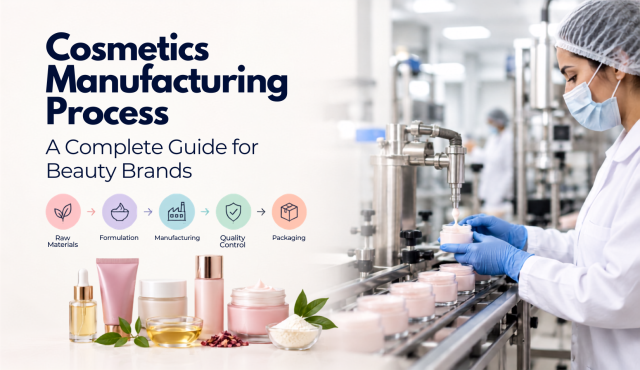
The cosmetics manufacturing process is the foundation behind every safe, effective, and market-ready beauty product, from face serums and moisturizers to shampoos, makeup, and hair care formulations.
As the global beauty market continues to expand, McKinsey estimates it could reach $590 billion by 2030, growing at approximately 5% annually. India is also emerging as a major beauty market, with its beauty and personal care sector projected to reach around US$30 billion by 2027.
But how are cosmetics actually manufactured? What happens between product formulation and final packaging? This guide explains the complete cosmetic manufacturing process, including product development, ingredient sourcing, formulation, mixing, filling, quality testing, packaging, and regulatory compliance.
Whether you are a beauty startup, established cosmetics brand, or exploring contract cosmetic manufacturing, understanding these stages can help you make better decisions on quality, scalability, cost, and product performance.
What Is Cosmetics Manufacturing?
Cosmetics manufacturing is the systematic process of transforming carefully selected raw materials into finished beauty and personal care products that are safe, stable, effective, and ready for sale.
It involves multiple stages, including ingredient sourcing, formulation, weighing, blending, heating or emulsification, quality testing, filling, labeling, and packaging. Depending on the product, manufacturers may produce creams, lotions, serums, shampoos, makeup, and other cosmetic formulations.
Brands can manufacture products in-house or work with contract cosmetic manufacturers that provide formulation, production, testing, and packaging expertise.
Why Is the Cosmetics Manufacturing Process Important for Beauty Brands?
A well-controlled cosmetics manufacturing process helps cosmetics business turn formulations into consistent, safe, and commercially viable products. Its importance extends beyond production:
1. Ensures Product Quality
Standardized manufacturing maintains consistency in texture, appearance, fragrance, performance, and shelf life across every batch.
2. Supports Product Safety
Controlled production, hygienic facilities, quality testing, and proper handling help reduce contamination and protect consumers.
3. Builds Consumer Trust
Consistent product performance and reliable quality strengthen customer confidence, reviews, repeat purchases, and brand reputation.
4. Helps Meet Regulatory Requirements
Following applicable cosmetic regulations, documentation, labeling, testing, and quality-control procedures helps brands meet legal and market requirements.
5. Enables Large-Scale Production
Efficient manufacturing systems allow beauty brands to increase production volumes while maintaining consistent quality, controlling costs, and meeting growing market demand.
For startups and established beauty companies alike, choosing the right cosmetics manufacturer and implementing robust production standards can significantly influence product success, scalability, and long-term brand credibility.
Step-by-Step Cosmetics Manufacturing Process
The cosmetics manufacturing process involves a sequence of controlled steps designed to transform a product concept into a safe, consistent, and market-ready beauty product. While exact procedures vary by formulation and manufacturer, the typical process includes:
Step 1: Product Concept and Market Research
The process begins by identifying the target customer, market demand, product positioning, desired benefits, price point, and competitive landscape.
Step 2: Product Formulation Development
Cosmetic formulators develop the product by selecting suitable ingredients, concentrations, texture, fragrance, color, and performance characteristics.
Step 3: Raw Material Selection and Sourcing
Manufacturers source approved raw materials from reliable suppliers while evaluating specifications, quality, purity, compatibility, and documentation.
Step 4: Laboratory Testing and Prototype Evaluation
Small laboratory batches are produced and assessed for appearance, texture, fragrance, application, performance, and consumer suitability.
The formulation undergoes appropriate stability, compatibility, microbiological, and safety evaluations to determine whether it remains suitable throughout its intended shelf life.
Step 6: Scale-Up From Laboratory to Commercial Batch
Once the formulation is approved, manufacturing parameters are adapted from laboratory quantities to larger commercial batches without compromising consistency.
Step 7: Weighing and Dispensing of Ingredients
Each ingredient is accurately weighed and dispensed according to the approved manufacturing formula and batch documentation.
Step 8: Mixing and Manufacturing
Ingredients are processed using suitable equipment and controlled conditions. Depending on the product, this may involve mixing, heating, cooling, homogenization, emulsification, or other processes.
Step 9: In-Process Quality Control
During production, critical parameters such as temperature, pH, viscosity, appearance, weight, and mixing conditions are monitored to identify deviations early.
Step 10: Filling and Packaging
The approved bulk product is transferred into suitable containers such as bottles, jars, tubes, pumps, or sachets, followed by secondary packaging where required.
Step 11: Labeling and Coding
Products receive required labels, batch numbers, manufacturing details, expiry or relevant period-after-opening information, and other applicable information.
Step 12: Finished Product Quality Testing
The completed batch undergoes final quality checks to confirm that it meets predefined specifications for appearance, physical properties, microbiological quality, and other applicable requirements.
Step 13: Quality Assurance and Batch Release
Quality assurance reviews manufacturing records, test results, deviations, and documentation before authorizing the batch for release.
Step 14: Storage and Warehousing
Released cosmetics are stored under appropriate environmental conditions to protect product quality and packaging integrity.
Step 15: Final Dispatch and Distribution
Finally, finished products are prepared for shipment and distributed to retailers, distributors, marketplaces, or directly to customers, completing the cosmetics manufacturing cycle.
How to Choose a Cosmetics Manufacturer for Your Beauty Brand?
Choosing the right cosmetics manufacturer can significantly influence your product quality, costs, launch timeline, and brand reputation. Start by evaluating the manufacturer’s experience with your product category, such as skincare, haircare, makeup, or personal care.
Check their formulation capabilities, manufacturing facilities, quality-control systems, certifications, testing procedures, and regulatory compliance. Ask about minimum order quantities, production capacity, lead times, packaging support, and customization options.
A reliable manufacturer should also provide clear documentation, transparent pricing, and effective communication throughout production. For growing beauty brands, consider whether the manufacturer can scale with increasing demand.
Reviewing samples, factory capabilities, client experience, and quality standards before signing an agreement can help minimize production risks and establish a dependable long-term partnership.
Conclusion:
The cosmetics manufacturing process is a carefully controlled journey that transforms an initial beauty product concept into a safe, consistent, and market-ready product. From formulation development and raw material sourcing to testing, production, packaging, quality assurance, and distribution, every stage plays an important role in delivering products that meet consumer expectations and applicable industry requirements.
For beauty startups and established brands, partnering with an experienced cosmetics manufacturer can simplify production while improving quality, scalability, and operational efficiency. RevieraOverseas can be a valuable manufacturing partner for brands looking to develop and produce cosmetics with professional expertise and reliable processes.
Understanding each manufacturing stage also helps brands make informed decisions about formulations, packaging, production volumes, testing, and compliance. With the right manufacturing strategy and quality-focused partner, beauty brands can confidently bring innovative products to market and build lasting consumer trust.